Predictive ROI Marketing Tools are becoming a major part of how brands plan campaigns today, especially before investing heavily into Q2 advertising.
And honestly, it’s easy to understand why.
Running ads now feels completely different compared to a few years ago.
Budgets disappear quickly. Competition keeps increasing. Audience attention shifts faster than ever. Sometimes, even campaigns with strong creatives and proper targeting fail without giving marketers a clear explanation.
That uncertainty is pushing businesses toward a different way of planning.
Instead of launching campaigns first and fixing problems later, brands now want to understand potential risks before spending begins.
Questions like:
- Is this campaign likely to convert?
- Are we targeting the right audience?
- Will increasing budget actually improve performance?
- Is the creative strong enough to survive for weeks?
- Are there funnel issues hurting conversions already?
This is exactly where Predictive ROI Marketing Tools are changing the conversation.
They don’t guarantee success.
But they help businesses make smarter decisions before campaigns go live.
And in today’s advertising environment, that matters a lot.
Why Traditional Campaign Planning Feels Riskier Now
For years, most businesses followed almost the same advertising process.
Create creatives.
Set targeting.
Launch ads.
Watch performance.
Optimize later.
The problem is that “optimize later” has become expensive.
Very expensive.
By the time businesses notice weak conversions or rising acquisition costs, a large part of the budget is already gone. In competitive quarters like Q2, recovering from those mistakes becomes much harder because ad costs are already higher.
Platforms are also changing constantly.
What worked six months ago may suddenly stop performing.
Audiences scroll faster. Trends move faster. Creatives fatigue faster. Algorithms change without warning.
Because of this, marketers are slowly shifting away from reactive advertising and moving toward predictive planning.
Instead of asking:
“Why didn’t this campaign work?”
They’re trying to ask:
“What signals suggest this campaign may struggle before launch?”
That mindset shift is becoming one of the biggest changes in modern marketing.
So What Exactly Are Predictive ROI Marketing Tools?
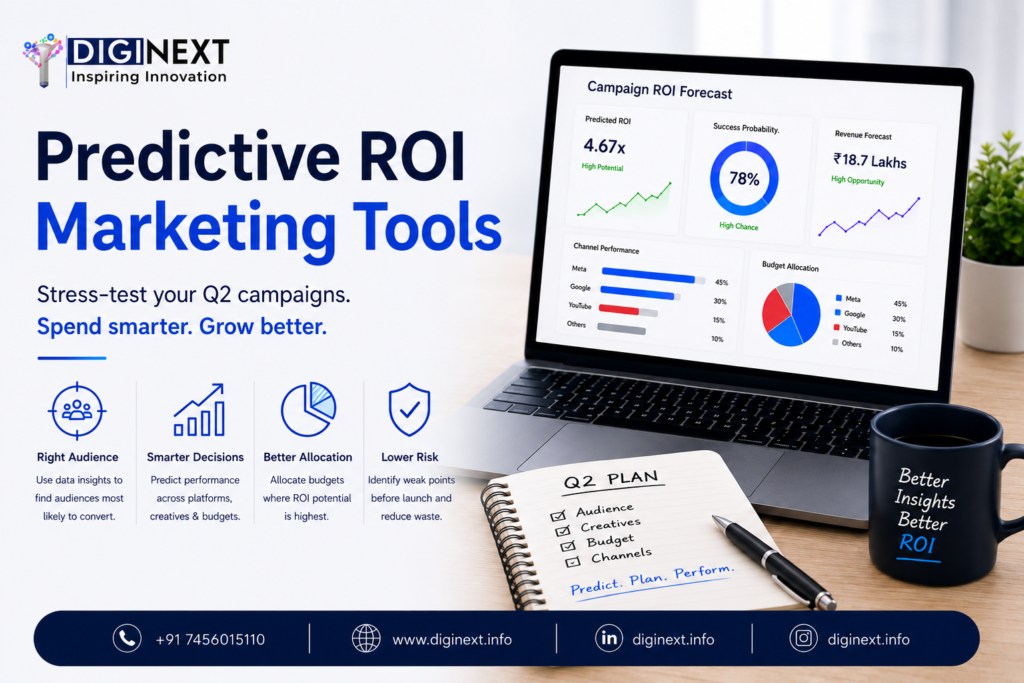
In simple words, these tools use AI and historical campaign data to estimate how campaigns may perform before businesses spend aggressively.
They study patterns like:
- Audience behavior
- Conversion trends
- Previous campaign performance
- Engagement quality
- Budget efficiency
- Seasonal demand shifts
- Customer intent signals
The goal is not to predict the future perfectly.
Marketing will always involve uncertainty because people constantly change their behavior.
The real purpose is reducing avoidable mistakes.
These tools help brands make more informed decisions around:
- Budget allocation
- Platform selection
- Audience targeting
- Creative planning
- Scaling strategy
- Revenue forecasting
You can think of it like stress-testing a campaign before putting large amounts of money behind it.
And honestly, that approach makes sense now.
Because advertising has become too expensive for businesses to rely only on trial and error.
Why More Brands Are Taking Predictive Marketing Seriously
One major reason is simple:
Efficiency matters more now.
A few years ago, many businesses could afford to spend money experimenting until they found something that worked.
Today, that approach feels harder to sustain.
Competition has increased across almost every industry. Ad inventory is crowded. Customer attention is fragmented. Even good campaigns sometimes struggle because the market itself has become noisier.
That’s why businesses are trying to improve decision-making before launch instead of depending completely on post-launch optimization.
Predictive ROI Marketing Tools help answer questions like:
- Which audience may convert better?
- Which platform may offer lower acquisition costs?
- Is the campaign likely to scale profitably?
- Will creative fatigue happen too quickly?
- Are there hidden funnel issues affecting conversions?
Even partial clarity on these questions can improve campaign performance significantly.
And small improvements matter more than people realize.
Sometimes avoiding one weak campaign saves more money than launching two successful ones.
Why Q2 Campaign Planning Needs More Precision
Q2 is usually one of the most competitive periods for advertising.
Many brands increase spending during this phase because they want stronger mid-year growth momentum.
That means:
- Higher CPMs
- More aggressive competition
- Faster creative saturation
- Increased audience fatigue
- Greater pressure on ROI
In this kind of environment, poor planning becomes expensive very quickly.
Businesses cannot afford to scale blindly anymore.
This is one of the biggest reasons Predictive ROI Marketing Tools planning is becoming more valuable during Q2 campaign preparation.
Instead of entering campaigns with uncertainty, brands now want better visibility before spending increases.
Not perfect certainty.
Just smarter clarity.
And there’s a difference.
How Businesses Are Stress-Testing Campaigns Before Launch
Looking Beyond Surface-Level Metrics
Most businesses already have campaign data available.
The issue is that many only focus on surface-level numbers like:
- Reach
- Impressions
- Clicks
- Engagement
Those numbers may look good in reports, but they don’t always explain actual business performance.
Predictive ROI Marketing Tools systems usually go deeper.
They analyze things like:
- Conversion quality
- Customer retention
- Purchase intent
- Revenue consistency
- Funnel drop-offs
- Seasonal buying behavior
For example, a campaign may generate huge traffic numbers but still produce weak sales quality.
Without deeper analysis, businesses may incorrectly assume the campaign performed well.
That’s one reason Predictive ROI Marketing Tools analysis is becoming more useful.
It focuses less on vanity metrics and more on business outcomes.
Forecasting Creative Fatigue Earlier
Creative fatigue has become a serious challenge in digital advertising.
People are exposed to hundreds of ads every day.
Even strong creatives lose effectiveness after repeated exposure.
The difficult part is that many brands notice fatigue only after performance starts declining.
By then, results are already affected.
Predictive ROI Marketing Tools systems try to identify signs earlier.
They can help estimate:
- How long creatives may remain effective
- Which formats fatigue faster
- When engagement decline may begin
- Which audience segments lose interest earlier
This allows marketing teams to prepare backup creatives in advance instead of reacting after campaigns weaken.
That creates more performance stability, especially during aggressive Q2 campaigns.
Testing Different Budget Scenarios
One useful part of Predictive ROI Marketing Tools is campaign simulation.
Businesses can test different spending strategies before launching campaigns.
For example:
- Moderate spending vs aggressive scaling
- Broad targeting vs niche targeting
- Meta-heavy strategy vs Google-heavy strategy
Many brands assume increasing budget automatically improves results.
But that’s not always true.
Sometimes scaling too fast reduces profitability because acquisition costs rise faster than conversions.
Predictive ROI Marketing Tools systems help businesses identify those risks earlier.
And honestly, that alone can prevent a lot of wasted spending.
Identifying Funnel Problems Before Scaling
Not every marketing issue comes from the ads themselves.
Sometimes the actual problem exists inside the funnel.
A campaign may generate good traffic but weak sales because:
- Landing pages load slowly
- Mobile experience feels poor
- Checkout flow feels complicated
- Lead follow-up takes too long
- Trust signals are missing
Many businesses try solving these issues by increasing ad spend, but that usually doesn’t fix the core problem.
Predictive ROI Marketing Tools analysis can help identify funnel weaknesses earlier before businesses scale budgets aggressively.
In many situations, improving the funnel increases ROI faster than increasing advertising spend.
The Shift Away From Vanity Metrics
One noticeable change in modern marketing is the growing focus on profitability instead of attention alone.
For a long time, marketers celebrated numbers like:
- High impressions
- Viral engagement
- Large reach
- Click volume
But those numbers don’t always translate into business growth.
That’s why modern Predictive ROI Marketing Tools focus more on:
- Conversion probability
- Revenue forecasting
- Lead quality
- Purchase intent
- Customer lifetime value
- Profit sustainability
This changes the entire way campaigns are evaluated.
Instead of asking:
“Did people see the campaign?”
Businesses are starting to ask:
“Did the campaign generate profitable outcomes?”
That’s a much healthier approach for long-term growth.
AI Is Assisting Marketers — Not Replacing Them
There’s a common fear that AI-driven marketing tools are replacing marketers completely.
But that’s not really what’s happening.
Predictive ROI marketing tools improve analysis and forecasting.
They improve decision-making speed.
They reduce uncertainty.
But strong marketing still depends heavily on human thinking.
Things like:
- Creativity
- Emotional storytelling
- Consumer psychology
- Brand positioning
- Messaging
- Cultural understanding
AI can process data faster.
But human insight still shapes campaigns people emotionally connect with.
The strongest marketing teams today are combining both.
And honestly, that balance is where the real advantage exists.
Final Thoughts
Marketing is slowly becoming more Predictive ROI Marketing Tools.
Instead of relying only on post-launch optimization, businesses are trying to reduce uncertainty before campaigns even begin.
And that shift feels necessary now.
Advertising costs are rising. Competition is increasing. Audience attention is becoming harder to hold.
Businesses can no longer afford to spend heavily without understanding potential risks first.
Predictive ROI Marketing Tools may not guarantee perfect campaigns, but they can help brands make smarter decisions, improve efficiency, reduce wasted spend, and approach Q2 planning with far more clarity.
And in today’s market, smarter decisions often matter more than bigger budgets.
At Diginext, we believe modern marketing growth comes from combining strategy, creativity, audience understanding, and data-backed decision-making — not just running more ads.