Agentic AI Marketing Workflows are changing how businesses operate online. A few years ago, brands were excited when AI started writing captions and generating emails.
Now?
That’s the basic level.
The real shift is happening somewhere else.
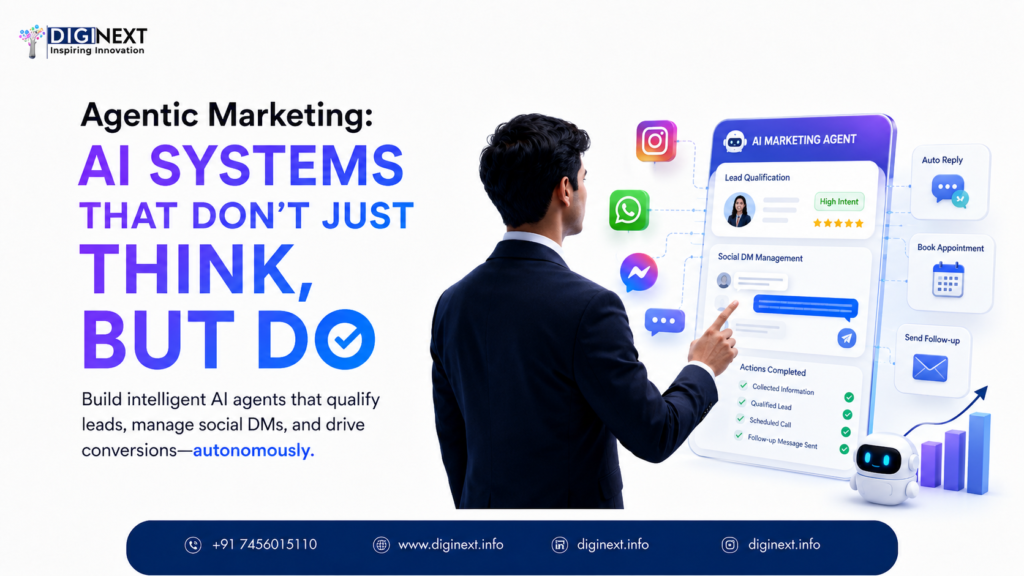
AI is slowly moving from “assistant” to “operator.” Instead of just suggesting ideas, it can now reply to leads, continue conversations, qualify potential customers, manage DMs, schedule meetings, and handle repetitive marketing tasks without someone manually controlling every step.
That’s exactly why Agentic AI Marketing Workflows are becoming such a big topic in marketing right now.
And honestly, most businesses still haven’t fully understood how massive this change is going to be.
What Are Agentic AI Marketing Workflows?
Most traditional automation systems work like a fixed checklist.
If this happens → do that.
For example:
- Someone fills a form → send email.
- Someone comments “Interested” → send a DM.
- Someone books a call → send confirmation.
Useful? Definitely.
But intelligent? Not really.
These systems follow instructions. They don’t actually think through situations or adapt naturally during conversations.
That’s where Agentic AI Marketing Workflows become different.
An AI agent can understand intent, continue conversations, ask follow-up questions, and make decisions based on customer behavior.
In simple words, it behaves less like a tool and more like a digital team member.
And that changes everything.
Why Businesses Are Suddenly Paying Attention
Most businesses don’t lose leads because their product is bad.
They lose leads because communication is slow.
Someone sends a message on Instagram.
The brand replies after 4 hours.
By then, the customer has already moved on.
People expect quick replies now. Social media has completely changed customer behavior. Whether it’s Instagram, WhatsApp, Facebook, or website chats, users want immediate interaction.
This is why businesses are investing heavily in AI systems that can respond instantly.
With Agentic AI Marketing Workflows, brands can:
- Handle conversations 24/7
- Reply within seconds
- Reduce manual workload
- Manage more leads together
- Improve conversion rates
- Keep communication consistent
And for small businesses, this becomes even more valuable because hiring large sales or support teams is expensive.
An AI system can manage hundreds of conversations at the same time without getting exhausted.
That’s a huge operational advantage.
Agentic AI Marketing Workflows Can Now Qualify Leads Automatically
Lead qualification used to take a lot of time.
Sales teams had to manually figure out:
- Is this person serious?
- What’s their budget?
- Are they ready to buy?
- What exactly do they need?
Now AI agents can handle most of this process automatically.
Imagine someone sends a message saying:
“I want help with digital marketing for my clothing brand.”
Instead of waiting for a human response, Agentic AI Marketing Workflows can immediately continue the conversation:
- Which city is your business based in?
- What platforms are you currently using?
- Are you looking for branding or sales?
- What’s your approximate marketing budget?
- How soon do you want to start?
These questions may sound simple, but they help businesses filter serious leads from casual inquiries.
The smartest part is what happens next.
The AI system can score the lead automatically.
If the customer seems highly interested, the system can:
- Notify the sales team
- Share a booking link
- Schedule a consultation
- Add the lead into a priority pipeline
Meanwhile, lower-intent leads can receive educational content or follow-up messages later.
This saves time and improves efficiency without making the process feel robotic.
Social DMs Are Becoming the New Sales Funnel
A lot of businesses still underestimate social media DMs.
But honestly, DMs are slowly becoming one of the biggest conversion channels online.
People don’t always want to fill lengthy forms anymore.
They prefer sending a quick message like:
“Price?”
“Available?”
“Can you share details?”
Now imagine getting 300+ messages daily and trying to respond manually.
That’s where AI agents become extremely useful.
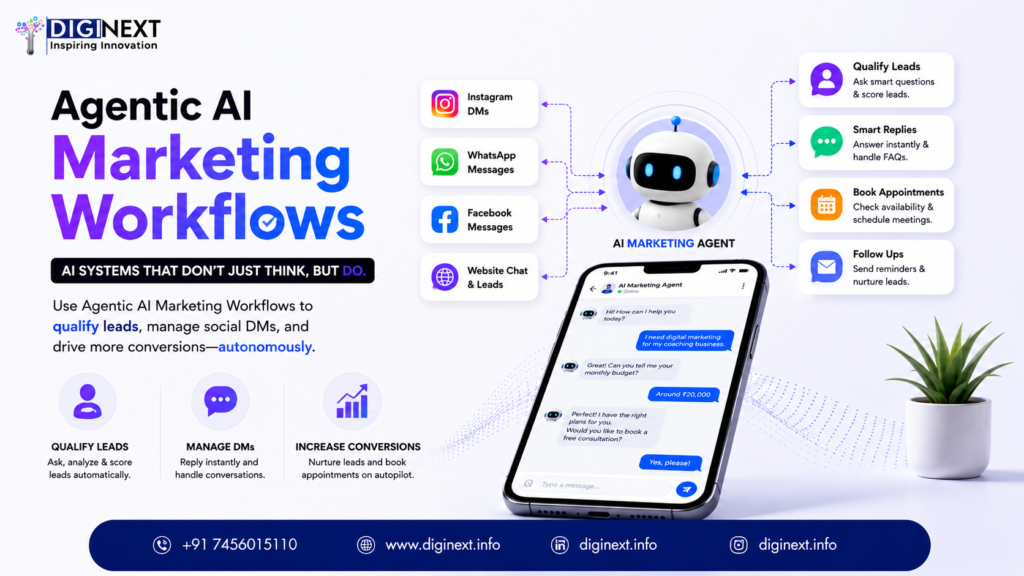
Modern AI systems can:
- Reply instantly
- Recommend products or services
- Answer FAQs
- Share pricing details
- Collect customer information
- Handle bookings
- Send reminders
- Continue follow-ups automatically
And unlike older chatbots, newer AI systems don’t always sound scripted.
That’s the biggest difference people notice immediately.
Instead of:
“Please choose option 1 or option 2.”
The conversation feels more natural and conversational.
That human-like interaction is what makes modern Agentic AI Marketing Workflows so powerful.
AI Agents vs Traditional Chatbots
A lot of people think AI agents are just upgraded chatbots.
But there’s actually a major difference.
Traditional chatbots usually follow pre-written flows. If the customer asks something unexpected, the system gets confused quickly.
AI agents work differently.
They can:
- Understand context
- Continue discussions naturally
- Adapt responses
- Connect with external tools
- Perform actions independently
- Learn from interactions over time
For example, a basic chatbot might only reply:
“Our package starts from ₹15,000.”
But an AI agent can:
- Understand the customer’s business type
- Recommend the right service package
- Ask additional qualifying questions
- Check available slots
- Schedule a consultation
- Send reminders automatically
That’s not just communication anymore.
That’s execution.
And execution is where the future of marketing is heading.
Why This Shift Matters So Much
The internet is becoming faster, noisier, and more competitive every year.
Attention spans are smaller. Customer patience is lower.
The businesses growing fastest are usually the ones responding fastest.
This is why Agentic AI Marketing Workflows matter beyond just automation.
They help brands create systems that operate continuously.
Even when the team is offline:
- Leads are getting qualified
- DMs are being managed
- Follow-ups are happening
- Appointments are being scheduled
That operational speed creates a huge advantage in crowded markets.
Especially for agencies, clinics, coaches, fashion brands, restaurants, salons, and local businesses trying to scale digitally.
But AI Still Needs Human Direction
Even though AI agents are impressive, they are not magic systems.
They still need proper training, supervision, and strategy.
Poorly designed workflows can:
- Sound repetitive
- Misunderstand customer emotions
- Give incorrect answers
- Create frustrating experiences
That’s why the smartest businesses are not replacing humans completely.
Instead, they are combining:
- Human creativity
- Human decision-making
- AI execution
- AI scalability
That balance works best.
Agentic AI Marketing Workflows handles repetitive operational tasks while humans focus on storytelling, branding, creativity, and relationship building.
Final Thoughts
Marketing is changing much faster than most businesses expected.
AI is no longer limited to generating ideas or writing captions. It is now entering the execution stage.
And that is exactly why Agentic AI Marketing Workflows are becoming one of the most important systems in modern marketing.
From managing social DMs to qualifying leads automatically, AI agents are helping brands build faster communication, smoother customer journeys, and more scalable operations.
The businesses adapting early will likely have a major advantage over the next few years.
Because the future will not belong to brands that only use AI for content creation.
It will belong to brands that use Agentic AI Marketing Workflows to actually get things done.
And if you want to understand how businesses are using AI, automation, and modern digital systems to scale smarter, you can also explore more marketing insights and future-focused strategies from Diginext.