AI Search Optimization is becoming one of the most important topics in digital marketing today.
A few weeks ago, I was talking to a business owner about their website.
The conversation started the way most marketing conversations do.
“How can we get more traffic?”
Naturally, we started discussing SEO, content, keywords, and rankings. Then they asked something that completely changed the direction of the discussion.
“If people are using ChatGPT now, do they even visit websites anymore?”
It’s a question that more business owners are asking in 2026.
And honestly, it’s a valid one.
For years, the digital marketing formula felt straightforward. You built a website, worked on SEO, ranked on Google, and hoped people would click through to learn more about your business.
Today, things look a little different.
People still use search engines, but they’re also turning to AI tools for answers. They ask ChatGPT for recommendations. They use AI Overviews to get quick summaries. They ask conversational questions instead of typing short keywords into a search bar.
That shift is creating a lot of uncertainty for businesses.
Some people believe SEO is dying.
Others think websites won’t matter in the future.
From what I’m seeing, neither is true.
What’s actually happening is that search is evolving. And businesses that understand this change early will be in a much stronger position over the next few years.
That’s where AI Search Optimization comes in.
AI Search Optimization Has Changed More in the Last Two Years Than Many People Realize
Think about your own behavior for a moment.
A year or two ago, if you wanted information, you probably opened Google, typed a search query, and clicked through a few websites.
Now?
There’s a good chance you’ve asked ChatGPT questions that you would have previously searched for online.
Maybe it was:
“What’s the best CRM for a small business?”
Or:
“How can I improve my website conversions?”
Or even:
“Create a marketing strategy for my local business.”
Instead of reviewing multiple articles, you receive a direct answer within seconds.
That’s exactly why businesses need to start paying attention to AI Search Optimization.
The goal is no longer just appearing in search results.
The goal is becoming a source of information that AI systems trust enough to reference when generating answers.
And that’s a very different challenge.
The Biggest Misconception About AI Search Optimization
One thing I’ve noticed recently is that many people think AI Search Optimization is some kind of secret technical strategy.
Almost every week, I see posts claiming they’ve discovered the latest AI ranking hack.
The reality is much less exciting.
Most of the fundamentals haven’t changed.
AI systems aren’t searching for tricks.
They’re searching for useful information.
Think about how you use AI yourself.
When you ask a question, do you want a response filled with keywords?
Of course not.
You want the clearest and most helpful answer possible.
That’s exactly what AI systems are trying to deliver to users.
The businesses that succeed won’t necessarily be the ones publishing the most content.
They’ll be the ones publishing content that genuinely helps people.
Why Generic Content Is Becoming a Bigger Problem
A few months ago, I was researching a topic for a client.
After opening several articles, I noticed something strange.
The websites were different.
The designs were different.
The authors were different.
But the content felt almost identical.
The same advice.
The same examples.
The same structure.
It felt like everyone was rewriting the same article.
This is becoming one of the biggest challenges on the internet.
AI has made content creation easier than ever.
But it has also made generic content easier than ever.
As a result, standing out now requires something many businesses overlook:
Real experience.
If you’ve worked with customers, share what you’ve learned.
If you’ve helped clients solve problems, talk about the lessons you discovered.
If you’ve made mistakes, write about those too.
Those insights can’t be copied as easily because they come from actual experience.
And that’s exactly the kind of content that both people and AI systems find valuable.
Your Customers Are Already Telling You What Content to Create
One of the best content strategies I’ve ever seen doesn’t involve expensive tools.
It starts with listening.
Every business receives questions from customers.
Sometimes through phone calls.
Sometimes through WhatsApp.
Sometimes through emails or social media messages.
Most businesses answer those questions and move on.
The smarter businesses turn those questions into content.
If customers regularly ask:
“How much does SEO cost?”
Write about it.
If people ask:
“How long does digital marketing take to show results?”
Write about it.
If clients ask:
“Do I need a new website or can I improve my existing one?”
Write about it.
The reason this works is simple.
Those are real questions from real people.
And AI tools are built to answer exactly those kinds of questions.
The more effectively your website answers them, the stronger your AI Search Optimization becomes.
Authority Matters More Than Volume
For years, businesses were told they needed to publish more content.
More blogs.
More pages.
More keywords.
More everything.
But recently, I’ve noticed something interesting.
Some websites publish dozens of articles every month and struggle to gain traction.
Others publish far less content but become trusted resources within their industry.
The difference usually comes down to authority.
Imagine you’re looking for advice about digital marketing.
Would you trust a website that occasionally posts marketing articles alongside random content about travel, fitness, and cooking?
Or would you trust a website that consistently publishes valuable marketing insights?
Most people would choose the second option.
AI systems think similarly.
They want to identify expertise.
They want to understand which websites genuinely know a subject.
That’s why businesses should focus on building depth rather than simply chasing content volume.
The Human Side of Content Is Becoming More Important in AI Search Optimization
Ironically, as AI becomes more common, human perspectives are becoming more valuable.
People don’t just want information.
They want context.
They want opinions.
They want experiences.
They want stories.
Think about the articles you remember reading.
Chances are, they weren’t memorable because of statistics or keywords.
They were memorable because someone shared an insight, experience, or perspective that felt authentic.
The same principle applies to AI Search Optimization.
The goal isn’t to sound robotic.
The goal is to sound useful.
And usefulness often comes from sharing things you’ve actually seen, learned, or experienced.
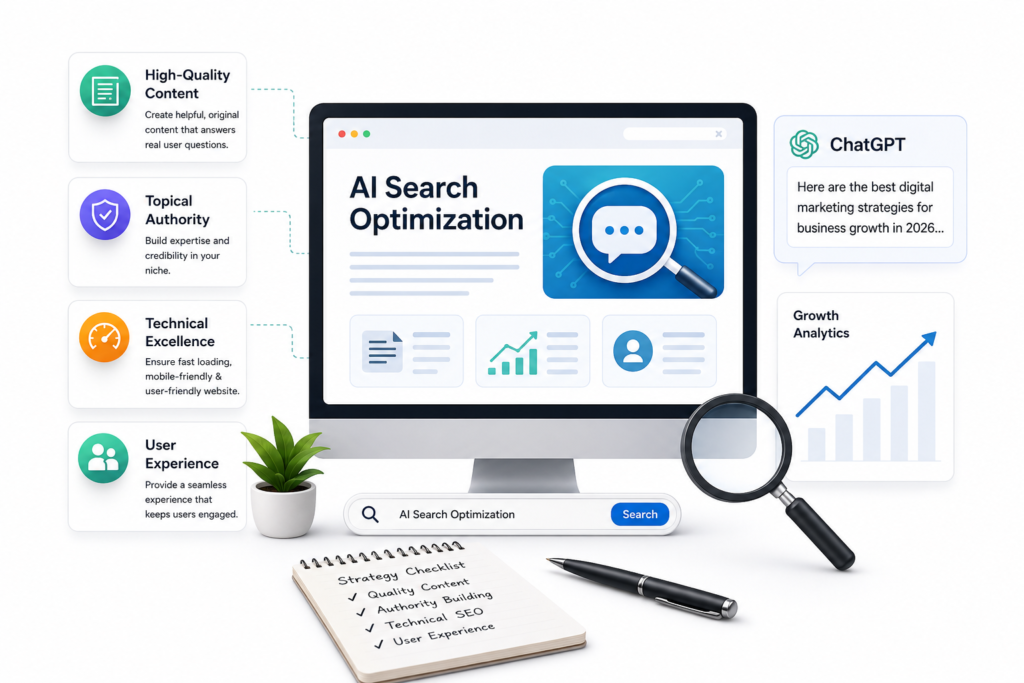
Don’t Forget the Technical Basics of AI Search Optimization
While content is incredibly important, technical foundations still matter.
I’ve seen businesses spend months creating content only to discover that their website loads slowly or has major usability issues.
That’s like opening a beautiful store and forgetting to unlock the front door.
Some areas worth paying attention to include:
- Website speed
- Mobile responsiveness
- Clear navigation
- Internal linking
- Structured page layouts
- Proper indexing
None of these things are particularly exciting.
But they make it easier for both users and search systems to access your content.
And when combined with strong content, they create a much stronger overall digital presence.
What the Future of AI Search Optimization Probably Looks Like
Nobody knows exactly how AI Search Optimization will evolve over the next five years.
Anyone claiming they do is probably guessing.
But some trends are becoming clear.
People want answers faster.
They prefer conversational interactions.
They increasingly use AI tools during research and decision-making.
At the same time, AI systems still need trustworthy sources.
They can’t generate quality answers without quality information.
That’s why websites aren’t disappearing.
In many ways, they’re becoming even more important.
The businesses that succeed won’t be those trying to manipulate algorithms.
They’ll be the businesses that consistently create useful, trustworthy information.
Final Thoughts on AI Search Optimization
If there’s one thing I’ve learned from watching digital marketing evolve, it’s that technology changes much faster than human behavior.
People still want answers.
People still want solutions.
People still want to trust the businesses they buy from.
The tools may change, but those needs remain the same.
That’s why AI Search Optimization isn’t really about optimizing for machines.
It’s about becoming the most helpful source of information in your industry.
When your website answers real questions, shares genuine expertise, and helps people make better decisions, you’re already moving in the right direction.
The businesses that focus on trust, experience, and value will be the ones most likely to stay visible as AI Search Optimization continues to grow.
And if you’re looking to prepare your website for the future while strengthening your overall digital presence, Diginext helps businesses create content strategies that work not only for traditional search engines but also for the next generation of AI-driven discovery.