
Search used to be simple. Someone typed a query into Google, scrolled through a list of blue links, and clicked a website. Today, it’s very different. Whether someone searches on Google or Bing, or even asks ChatGPT a question, they’re often shown a direct, AI-generated answer at the top. In many cases, they never even need to click a link.
That shift is reshaping digital visibility.
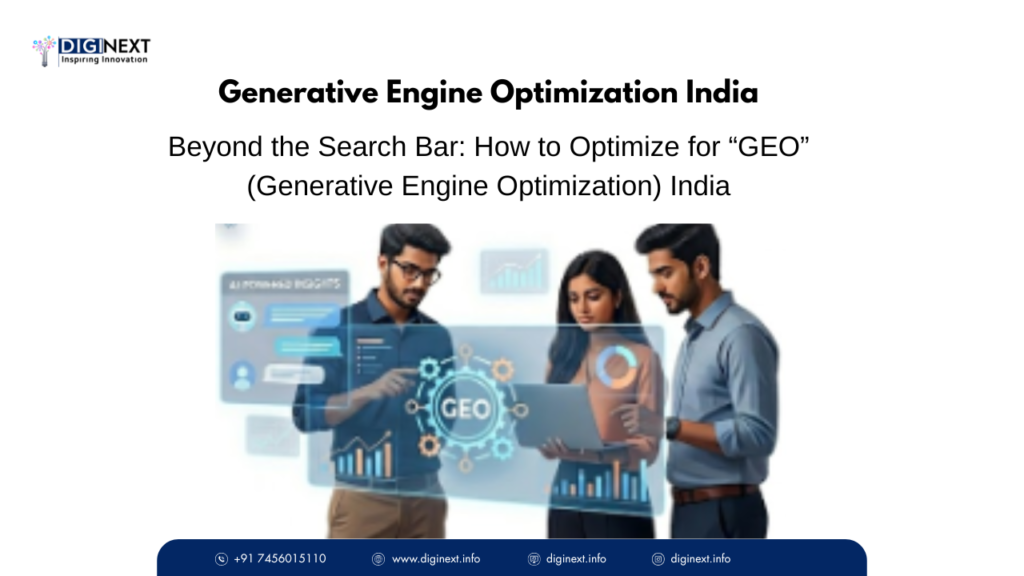
For businesses in India, this means one clear thing: traditional SEO alone is no longer enough. Ranking on page one still matters — but now, brands also need to think about how they appear inside AI-generated answers. This is where Generative Engine Optimization (GEO) comes in.
At DIGINEXT, we see GEO as the next evolution of search strategy. It’s not just about getting traffic. It’s about becoming a source that AI platforms trust, reference, and surface in their responses. When AI tools summarize a topic, recommend services, or compare solutions, you want your brand to be part of that conversation.
In simple terms, the goal is no longer just visibility in search results — it’s visibility in answers.
What is Generative Engine Optimization India?
Generative Engine Optimization India refers to optimizing your content so that AI-powered search engines and tools use your website as a trusted source in their summaries.
Instead of just asking: “Are we ranking on Google?”
You now need to ask:
“Is AI using our content in its answers?”
AI tools collect information from multiple trusted websites and create a summary. If your brand becomes a source, your authority grows — even if users don’t click immediately.
This is not replacing SEO. It is the next layer of SEO.
Why Generative Engine Optimization India Matters Now
Search behavior in India is changing quickly.
More users are:
• Asking longer, conversational questions
• Searching in Hindi and regional languages
• Using AI chat tools for quick answers
• Trusting summarized results instead of browsing 5–6 websites
For businesses, this means:
• Fewer clicks, but higher intent
• Higher importance of trust and authority
• Content quality matters more than keyword stuffing
If your website is not structured clearly, AI will skip it. That is why Generative Engine Optimization India is becoming essential.
SEO vs Generative Engine Optimization India
Traditional SEO focuses on:
• Ranking for keywords
• Backlinks
• Meta titles and descriptions
• Click-through rates
Generative Engine Optimization India focuses on:
• Clear answers to specific questions
• Well-structured content
• Authority signals
• Context depth
• Trustworthy information
Earlier, ranking was enough.
Now, your content must be understandable by machines in seconds.
How AI Selects Content for Summaries
AI models prefer content that is:
• Structured with headings and subheadings
• Written in simple language
• Fact-based and clear
• Not overly promotional
• Authoritative and trustworthy
If your content sounds like pure marketing, it is less likely to be used and If it sounds helpful, balanced, and informative — it has higher chances.
At DIGINEXT, we are already aligning content strategies with this shift.
Practical Strategies for Generative Engine Optimization India
Here are practical ways Indian brands can optimize for Generative Engine Optimization India.
1. Write for Questions, Not Just Keywords
Instead of targeting: Digital Marketing Company India
Create content around:
• What does a digital marketing company actually do?
• How much does digital marketing cost in India?
• Is SEO still effective in 2026?
AI prefers question-based content.
2. Use Clear H2 and H3 Headings
Structure matters as when your blog is divided into clean sections, AI understands context easily. Avoid long, confusing paragraphs.
Clarity increases visibility.
3. Build Topical Authority
Do not write one article and stop.
If you are in:
• Healthcare
• Real estate
• EdTech
• E-commerce
Build clusters of related content.
Instead of publishing just one generic blog on SEO, think bigger and build real depth around the topic.
For example, rather than writing a single article called “SEO Guide,” you could create focused pieces like:
- SEO Basics
- Local SEO in India
- Technical SEO
- Generative Engine Optimization (GEO) in India
- The Role of AI in Digital Marketing
When you do this, you’re not just posting content — you’re building authority. Search engines and AI platforms start to see your website as a specialist, not just another blog. That subject depth makes a big difference in how your brand is discovered and recommended.
4. Use Structured Data (Schema) to Help Search Engines Understand You
Search engines are smart — but they still need clarity.
Structured data (also called schema markup) helps them clearly understand what your content represents. It can define things like:
- FAQs
- Reviews
- Products
- Articles
- Organization details
Google explains structured data in detail through its official Search Central documentation, and it’s worth reviewing their guidelines to implement it properly.
When you use schema correctly, your content has a better chance of appearing in rich results — like featured snippets, FAQs, and sometimes even AI-generated summaries. It’s a technical step, but it has very practical visibility benefits.
5. Focus on E-E-A-T: Experience, Expertise, Authority, and Trust
Google places strong emphasis on E-E-A-T in its quality guidelines, and AI platforms follow similar principles when selecting sources.
For Indian brands, this means showing proof — not just making claims.
You can strengthen trust by:
- Adding clear author bios
- Showcasing real case studies
- Highlighting your industry experience
- Displaying client testimonials
- Keeping your contact information easy to find
- The goal is simple: build credibility.
AI tools are more likely to reference and recommend content from sources that demonstrate real expertise and transparency. When your brand clearly shows who you are, what you’ve done, and why you’re qualified, you naturally increase your chances of being featured.
6. Keep Language Simple and Human
Overly complex or robotic writing does not perform well.
Generative Engine Optimization India works best when:
• Sentences are clear
• Ideas are structured
• Tone is helpful
• Information is practical
Simple wins.
The Indian Market Advantage
India is unique.
We have:
• A massive mobile-first audience
• Rapid AI adoption
• Multiple languages
• High search volume growth
Brands that adapt early will dominate.
Companies that depend only on old SEO tactics will slowly lose visibility.
Generative Engine Optimization India is not a trend. It is a shift.
Internal Strategy at DIGINEXT
At DIGINEXT, we are already:
• Creating long-form authority content
• Optimizing for conversational queries
• Structuring blogs for AI readability
• Integrating schema markup
• Building content clusters
• Monitoring AI answer inclusion
Our SEO services page explains how we approach search strategy in detail.
We are also developing AI-first content frameworks for brands across industries.
Because visibility tomorrow will not look like visibility yesterday.
Measuring Success in Generative Engine Optimization India
You might be thinking — how do we actually measure this?
Since AI search is still evolving, there isn’t one single dashboard that shows everything clearly. But there are early signs that tell you your Generative Engine Optimization India strategy is working.
Here’s what we usually look at:
• Your impressions are increasing, even if clicks are not rising at the same speed
• More people are searching your brand name directly
• Clients mention they “saw you in an AI answer”
• Your website starts getting referenced as a trusted source
• Engagement quality improves — fewer visitors, but better leads
This is not an overnight result strategy.
It builds gradually. But brands that start now will be far ahead when AI summaries become the default way people search.
Common Mistakes to Avoid
As businesses in India begin adapting to Generative Engine Optimization India, we’re also seeing some common mistakes.
Avoid these:
- Simply copying and pasting AI-generated content without adding real insight
- Stuffing keywords everywhere just to rank
- Writing content that sounds robotic or overly technical
- Ignoring technical basics like site speed and structure
- Publishing short blogs that don’t actually solve a user’s problem
AI systems are becoming smarter every month.
If your content feels forced or shallow, it won’t be picked up. Real clarity and real value still matter the most.
The Future of Search in India
Search is changing in front of us.
Earlier, users clicked on links and explored websites. Today, many of them read a summary and move on. Voice searches, AI chat tools, and smart assistants are becoming part of daily life — especially among young and mobile-first Indian users.
So, what does your brand need to focus on?
- Speak clearly
- Share genuine expertise
- Structure your content properly
- Actually, answer real questions
That’s what Generative Engine Optimization India is about.
Final Thoughts
At DIGINEXT, we see this shift as an opportunity.
The brands that educate, simplify, and provide real value will lead the AI-driven search era.
If your business still focuses only on traditional rankings, it is time to rethink your strategy.
Generative Engine Optimization India is not optional anymore, it is the future of digital visibility.
If you would like to future-proof your SEO strategy, explore our Digital Marketing Solutions or connect with our team for a consultation.
The search journey has changed so let’s build for what comes next.