
For most Indian small and medium businesses, 2026 won’t be about spending more on marketing. It will be about spending smarter. Rising ad costs, shorter attention spans, and tougher competition mean that every rupee in your Digital Marketing Budget 2026 must justify itself with measurable returns.
Whether you run a local service business, an e-commerce brand, a coaching institute, or a B2B company, the question is no longer “Should we market online?”
The real question is: Where should we invest to actually see ROI?
This guide breaks down how Indian SMBs should plan, divide, and prioritise their marketing budget in 2026—based on what’s working on the ground, not theory.
Why 2026 Demands a Rethink of Marketing Budgets
Until a few years ago, digital marketing felt simple. Run some Facebook ads, boost a few posts, maybe do SEO, and leads would come in. That phase is over.
In 2026, Indian SMBs are facing:
- Higher competition in almost every niche
- Rising cost per click on Meta and Google
- Customers who research deeply before buying
- Shorter trust cycles and higher skepticism
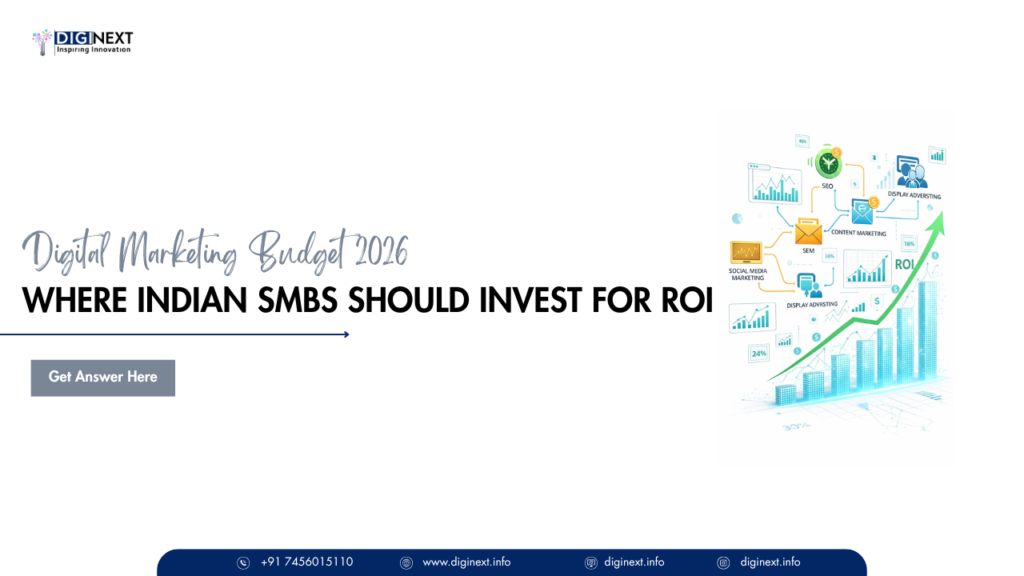
This means your Digital Marketing Budget 2026 must balance visibility, trust, and conversion—not just traffic.
Step One: Decide Your Growth Goal Before the Budget
Before splitting your budget into channels, define why you’re spending.
Ask yourself:
- Do I want more leads?
- Do I want stronger brand recall in my city or niche?
- Do I want repeat customers and higher lifetime value?
- Do I want scale or stability?
A local salon, a real estate consultant, and an online course creator will all allocate budgets differently—even if the amount is the same.
Your budget should follow your goal, not trends.
Recommended Digital Marketing Budget Split for Indian SMBs in 2026
While exact percentages vary by industry, here’s a realistic framework that works for most SMBs in India:
1. Paid Advertising (30–40%)
Paid ads will still take the largest share of the Digital Marketing Budget 2026, but with more discipline than before.
Where to invest:
- Meta Ads (Facebook + Instagram) for demand generation
- Google Search Ads for high-intent buyers
- YouTube Ads for brand recall and education
Key shift for 2026:
Stop running ads only for “Buy Now.” Instead:
- Top-of-funnel awareness ads
- Middle-funnel trust ads (testimonials, reels, case studies)
- Bottom-funnel retargeting
SMBs that rely only on direct lead ads will struggle with rising costs.
2. Content Marketing & Personal Branding (20–25%)
Content is no longer optional. In 2026, it’s what reduces your ad costs and improves conversion rates.
This part of your Digital Marketing Budget 2026 should include:
- Reels and short-form videos (Instagram, YouTube Shorts)
- Educational posts and carousels
- Founder or expert-led content
- Basic video production and editing
People don’t trust logos anymore. They trust faces, stories, and consistency.
If your brand doesn’t show up regularly with value, ads alone won’t save you.
3. SEO & Long-Term Visibility (15–20%)
SEO is slow—but in 2026, it’s one of the most stable investments.
Why Indian SMBs should invest in SEO:
- Search intent is high-quality traffic
- Cost per lead reduces over time
- It supports ads and content together
Your SEO budget should cover:
- Website optimisation
- Local SEO (especially for service businesses)
- Blog content focused on buyer questions
- Basic technical fixes
Think of SEO as the foundation that supports everything else in your Digital Marketing Budget 2026.
4. CRM, Automation & Retention (10–15%)
This is where many SMBs lose money—not because they don’t get leads, but because they don’t follow up properly.
In 2026, budget for:
- A simple CRM system
- WhatsApp automation for follow-ups
- Email nurturing sequences
- Lead tracking and attribution
If you’re paying for leads but not tracking conversions, you’re guessing—not marketing.
Retention marketing often delivers the highest ROI with the lowest spend.
5. Experimentation & New Platforms (5–10%)
Every year brings new opportunities. In 2026, this could include:
- New ad formats
- Regional language content experiments
- Community building (Telegram, WhatsApp groups)
- Influencer collaborations at micro level
Keep a small portion of your Digital Marketing Budget 2026 flexible. SMBs that never experiment slowly become invisible.
What Indian SMBs Should Stop Spending On
Budget planning isn’t only about where to invest—it’s also about where to cut back.
In 2026, reconsider spending heavily on:
- Boosted posts without strategy
- Random influencer deals with no tracking
- Agencies that only report impressions and likes
- One-time campaigns with no follow-up system
Every activity should answer one question: How does this move the business forward?
Monthly vs Annual Budget Planning
Many SMBs make the mistake of planning month-to-month. That leads to panic decisions and inconsistent results.
A better approach for 2026:
- Plan your Digital Marketing Budget 2026 annually
- Review performance quarterly
- Optimise monthly, not restart monthly
Marketing rewards consistency, not bursts.
Measuring ROI the Right Way in 2026
ROI is not just leads or followers.
Track:
- Cost per qualified lead
- Conversion rate from lead to sale
- Customer acquisition cost
- Repeat purchase or referral rate
The smartest Indian SMBs in 2026 won’t ask, “How many likes did we get?”
They’ll ask, “How many profitable customers did this create?”
Final Thoughts: Budget Is a Strategy, Not a Number
Your Digital Marketing Budget 2026 is not an expense—it’s a growth decision.
If you want your 2026 digital marketing budget to be a true growth investment not just an expense you need a clear, data-driven roadmap. Diginext helps Indian SMBs build sustainable digital marketing strategies that balance short-term performance with long-term brand assets. With the right plan, consistent growth is possible without the biggest budget.
Indian SMBs that win in 2026 will:
- Invest consistently, not emotionally
- Build trust before pushing sales
- Balance short-term ads with long-term assets
- Track data and adapt fast
You don’t need the biggest budget.
You need the clearest plan.