
Multilingual Voice Search India is quietly changing how people actually search
Multilingual Voice Search India is not something that exploded overnight. It didn’t arrive with noise or headlines. It just slowly became a part of how people use the internet especially outside metro cities.
If you pay attention to how people around you search today, you’ll notice something subtle but important. People are not typing as much anymore. They’re speaking. And they’re not trying to sound “correct” while doing it.
A shop owner isn’t typing:
Best electronics store near me
He’s saying:
Mere paas accha electronics shop kaunsa hai?
A student looking for classes isn’t typing structured keywords either.
She’s asking:
Nearby coaching center kaha milega jo affordable ho?
It’s casual. It’s natural. It’s exactly how they would ask a real person.
And that’s what makes Multilingual Voice Search India so important right now. Because while users have already shifted, most brands are still stuck in the old way of creating content.
Why Multilingual Voice Search India is growing faster in Tier-2 and Tier-3 cities
To understand this shift properly, you have to step out of the metro mindset.
In Tier-2 and Tier-3 cities, the internet is used very differently. It’s more functional, more direct, and less filtered. People don’t overthink how they search. They just want quick, relevant answers.
Typing in English is not always comfortable. It takes effort. Sometimes it even feels unnecessary.
Speaking, on the other hand, is easy.
That’s why voice queries often sound like:
- Sabse accha salon mere paas kaunsa hai?
- Budget friendly gym nearby kaha milega?
- Family ke liye accha restaurant suggest karo
These are not polished search queries. They’re real thoughts, spoken out loud.
And this is exactly why Multilingual Voice Search India is not just a trend it’s a reflection of real behavior.
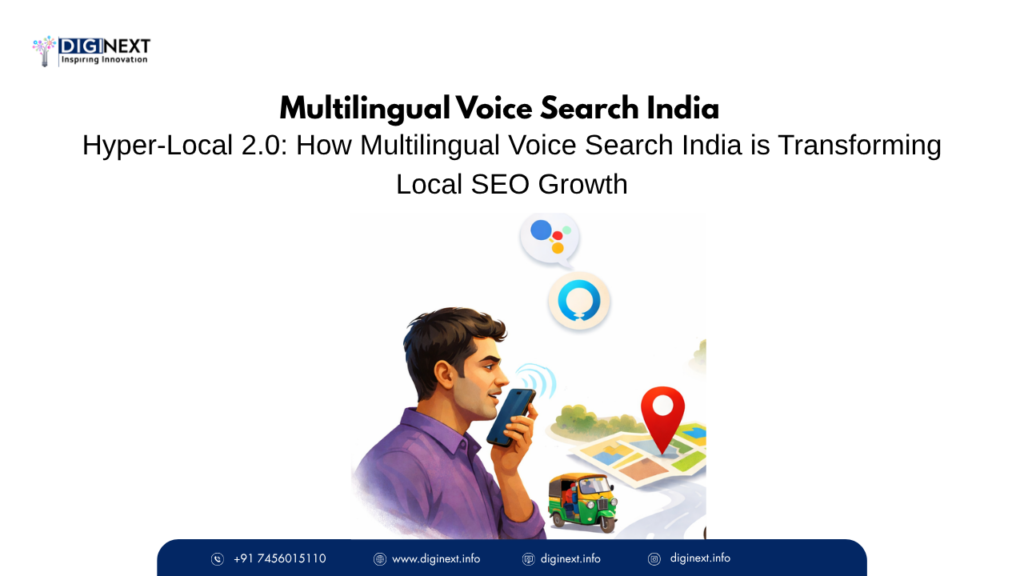
Multilingual Voice Search India from Local SEO to Hyper-Local 2.0: What Actually Changed
A few years ago, local SEO was relatively simple.
You would:
- Add “near me” in your keywords
- Optimize your Google Business profile
- Mention your city name multiple times
And that was enough to get visibility.
But now, the game feels different.
Because users are not just searching for “near me” anymore. They are adding context, preferences, and sometimes even expectations in the same query.
For example:
Mere paas affordable gym kaunsa hai jahan trainer bhi ho?
Now this tells you three things instantly:
- Budget matters
- Trainer is required
- Location is important
This is no longer a keyword. It’s a complete requirement.
That’s what Hyper-Local 2.0 looks like.
It’s not about inserting keywords anymore. It’s about understanding how people actually ask for things.
Why Multilingual Voice Search India is becoming the new local SEO driver
It feels more human
When users search in their own language, it doesn’t feel like they’re interacting with a machine.
It feels like they’re just asking a question like they would ask a friend or a shopkeeper.
That comfort level matters more than we think. Because when something feels natural, people trust it more.
It removes unnecessary effort
Typing, especially in a second language, creates friction.
You pause, think, correct, retype.
Voice removes all of that. You just speak.
And for a large part of India, that ease is the reason why voice search is becoming the default.
It gives clearer intent than traditional search
Short keywords don’t always tell the full story.
But voice queries do.
Instead of just “best salon,” a user might say:
Mere paas ladies salon kaunsa hai jahan haircut sasta ho?
Now you know exactly what they want.
This clarity is what makes Multilingual Voice Search India powerful for businesses that are willing to listen carefully.
How to actually optimize for Multilingual Voice Search India
This is where most brands either overthink or completely miss the point.
You don’t need to reinvent everything. You just need to shift your approach slightly.
Think in real questions, not SEO keywords
People don’t search in keywords anymore. They think in questions.
So instead of writing:
Best bakery in Moradabad
Try thinking like your audience:
Moradabad mein fresh cake kaha milega?
If your content answers this clearly, you’re already aligned with how people search.
Use Hinglish naturally, not forcefully
You don’t have to translate everything into pure Hindi or stick strictly to English.
Most people naturally mix both.
That’s where relatability comes from.
But the key is to keep it natural. If it feels forced, it won’t work.
Keep your content simple and easy to scan
Voice search prefers clarity.
If your content is too long-winded or complicated, it won’t perform well.
Try to:
- Keep sentences shorter
- Answer questions early
- Avoid unnecessary jargon
Simple writing often works better than “perfect” writing.
Be specific because users are specific
Generic content is slowly losing its effectiveness.
Users are no longer searching broadly. They’re being very clear about what they want.
Instead of:
Best makeup artist
Write:
Affordable bridal makeup artist in Moradabad for small functions
It matches real search intent much better.
Treat your Google Business profile like a content asset
A lot of voice search results are pulled directly from Google Business listings.
So instead of treating it like a basic form, use it properly:
- Add FAQs in conversational tone
- Use real phrases in descriptions
- Encourage customers to leave detailed reviews
These small things help you appear in voice-based results.
Where most brands are still struggling
Even now, many brands are approaching SEO the old way.
They:
- Focus only on English keywords
- Try to sound overly professional
- Ignore conversational language
- Optimize for search engines, not people
And because of that, their content doesn’t match how users are actually searching today.
The gap is not technical. It’s behavioral.
The future of Multilingual Voice Search India
This shift is only going to grow stronger.
With voice assistants, AI tools, and smarter search experiences becoming more common, conversational queries will increase even more.
And in a country like India where language diversity is huge this becomes even more important.
Multilingual Voice Search India will not just influence SEO. It will shape how brands communicate online.
Especially in Tier-2 and Tier-3 markets, where growth is already happening fast.
Final thought
If your content still sounds like it’s written only to rank, there’s a chance it’s not connecting anymore.
Because people are not searching in a structured way.
They’re asking questions.
They’re mixing languages.
They’re expecting answers that feel natural.
And the brands that adapt to this shift early will stand out without needing to fight too hard for attention.
Want to build a strategy around Multilingual Voice Search India?
If you’re trying to grow in Tier-2 and Tier-3 markets, this is something you can’t ignore anymore.
At DigInext, the focus is not just on trends, but on understanding how people actually behave online and building strategies around that.
Learn more here: Diginext