
For years, chatbots were marketed as the future of customer interaction. AI Agents India popped up on websites, apps, and WhatsApp with cheerful greetings and preset replies. For a while, that felt impressive. But by 2026, it’s clear that AI Agents India have hit their limit. They answer questions. They don’t solve problems.
We’re now stepping into what many in the industry are calling the Agent Era—a shift where AI Agents India don’t just talk, but act. Especially in fast-growing markets, AI Agents India is no longer a buzz phrase. It’s becoming a serious business advantage.
This article breaks down why this shift is happening, what makes AI agents fundamentally different, and why Indian businesses are adopting them faster than most global peers.
The chatbot problem no one likes to admit
Let’s be honest. Most chatbots today are glorified FAQs.
They work well only when:
- The user asks the right question
- The answer already exists in a fixed flow
- No decision-making is required
The moment a customer says something slightly unexpected, the experience breaks.
“Sorry, I didn’t understand that.”
“Please choose one of the options.”
From a user’s point of view, this feels lazy. From a business point of view, it’s expensive automation that doesn’t scale with complexity.
Indian businesses—especially in real estate, education, healthcare, and D2C—don’t deal with simple queries. They deal with:
- Price negotiations
- Availability checks
- Custom requirements
- Multi-step follow-ups
A basic chatbot simply can’t handle this. That gap is exactly where AI agents step in.
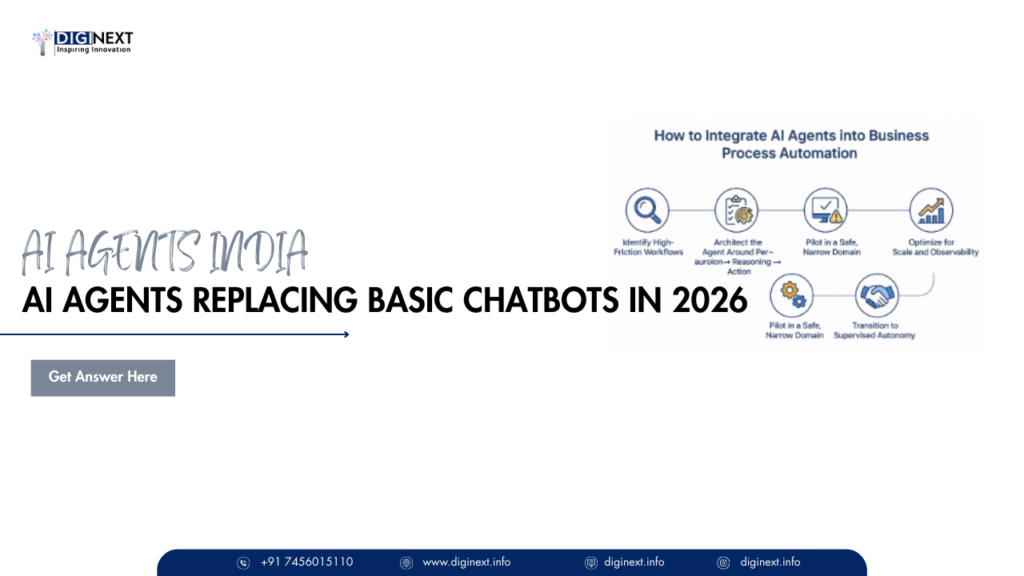
What exactly is an AI agent (and why it’s different)
An AI agent is not just a conversational interface. It’s a decision-capable system that can observe, reason, and act across tools.
Here’s the simplest way to understand it:
- Chatbot: Answers what you ask
- AI Agent India: Figures out what needs to be done and does it
An AI Agent India can:
- Pull data from your CRM
- Check inventory or availability
- Trigger emails or WhatsApp messages
- Update lead status
- Schedule meetings
- Escalate to humans only when needed
This is why AI Agents India is becoming a strategic conversation, not a technical one. Businesses aren’t asking, “Can it reply?” They’re asking, “Can it close, manage, or resolve?”
Why 2026 is the tipping point
This shift didn’t happen overnight. Three things aligned at the same time:
1. Better reasoning models
Modern AI systems can now hold context, remember goals, and plan steps. That wasn’t reliable even two years ago. Platforms like Open AI pushed the ecosystem forward by making reasoning-first models mainstream.
2. Tool connectivity became easier
APIs, CRMs, calendars, payment gateways, and ERPs are now easier to connect. An AI agent doesn’t live in isolation—it lives inside your business stack.
3. Businesses demanded ROI, not demos
In India especially, companies stopped paying for “cool tech.” They want measurable outcomes: fewer support tickets, faster lead closures, lower manpower cost.
By 2026, anything that doesn’t move a metric is considered noise.
Why India is adopting AI Agent India faster than expected
India isn’t just following the global trend. In many ways, it’s shaping it.
Here’s why AI Agents India is scaling so quickly:
High volume, high complexity markets
Indian businesses handle massive volumes of inquiries across languages, price sensitivities, and custom needs. Agents thrive in this environment because they adapt in real time.
Cost pressure on human teams
Hiring, training, and retaining support and sales teams is expensive. AI Agent India don’t replace humans—but they reduce dependency on repetitive roles.
WhatsApp-first behavior
India lives on WhatsApp. AI agents integrated with WhatsApp feel natural to users and powerful to businesses. A chatbot feels scripted. An AI Agent India feels helpful.
Faster decision cycles
Indian founders and managers are pragmatic. If something improves conversion or reduces workload, they adopt it—fast.
Real business use cases replacing chatbots
Let’s look at where agents are already outperforming traditional chatbots.
Sales qualification and follow-ups
An AI Agent India can:
- Ask dynamic questions
- Score leads
- Schedule calls
- Send personalized follow-ups
- Hand over hot leads to sales teams
A chatbot just collects name and number.
Customer support resolution
Instead of logging tickets, agents:
- Diagnose issues
- Check order or service status
- Offer solutions
- Issue refunds or escalations
Resolution, not redirection.
Internal operations
AI Agent India aren’t just external-facing. They:
- Prepare reports
- Track KPIs
- Nudge teams for pending tasks
- Summarize meetings
This is where the productivity gain really compounds.
Chatbots vs AI agents: the mindset shift
The biggest change isn’t technical. It’s mental.
Chatbots were built with the question:
“What should the user say next?”
AI Agent India are built with a different question:
“What outcome are we trying to achieve?”
This outcome-first thinking is why enterprise platforms like Salesforce and Microsoft are re-architecting their products around agents, not chat windows.
The interface may still look like a chat—but behind it is a system making decisions, prioritizing actions, and learning from results.
Common mistakes businesses make during adoption
Many companies fail with agents for one simple reason: they treat them like chatbots.
Some common errors:
- No clear goal defined (sales, support, ops?)
- Poor data quality in CRM
- Over-automation without human checkpoints
- Expecting magic in week one
Successful adoption starts small. One process. One metric. Then scale.
What thought leaders are getting right
True tech leadership in 2026 isn’t about saying “we use AI.” Everyone does.
It’s about:
- Redesigning workflows around agents
- Training teams to work with AI Agent India
- Measuring outcomes, not conversations
- Investing in systems, not gimmicks
This is where thought leadership meets execution—and where early adopters pull ahead.
The road ahead: from assistants to operators
The next evolution is already visible.
AI Agent India are moving from:
- Assistants → Executors → Operators
Soon, they won’t just support decisions. They’ll run entire micro-processes autonomously, with humans supervising outcomes instead of steps.
For Indian businesses, this isn’t a future scenario. It’s already happening in sales floors, support desks, and operations teams.
Final thoughts
Chatbots had their moment. They made automation approachable. But they were never built for scale, complexity, or accountability.
AI Agent India are different. They’re closer to digital employees than digital scripts.
And in a market as dynamic as India, AI Agents India isn’t just about technology adoption—it’s about staying relevant.
In 2026, the real question isn’t:
“Do you have a chatbot?”
It’s:
“Do you have agents working for your business—even when your team is offline?”
That’s where Diginext comes in—helping businesses design, deploy, and scale AI agents that actually work like a team, not just a tool.